
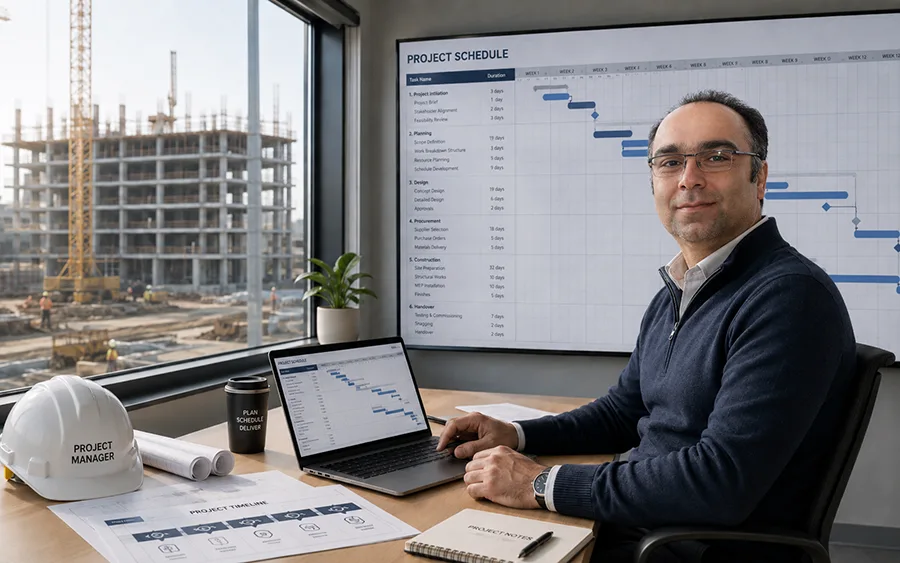
The project was designed to increase plant production capacity by approximately 300,000 tonnes annually, bringing total annual capacity to approximately 1.2 million tonnes. Engineering, procurement and construction progressed concurrently. Concurrent execution increased coordination complexity. Long-lead procurement, evolving engineering information, stakeholder interfaces and construction dependencies required an integrated controls approach. Because the project was still in early execution, the primary contribution was the establishment of the project-controls infrastructure required to manage execution effectively: structured scheduling, standardized progress measurement, procurement alignment, performance reporting, earned-value tracking, risk assessment and controlled evaluation of project changes.A major capacity expansion under fast-track execution.
Multiple workstreams. Changing information. Tight interfaces.
Building the controls infrastructure for execution.
A dependable management-control framework.
heading
asdasdasdasd
heading
asdasdasdasd